Environmentally Concerned Citizens of South Central Michigan


Monitoring Projects, 2001-2006

2006 Dissolved Oxygen Monitoring
Does partial waste treatment improve water quality near CAFOs?  Not yet.  Not at all. 

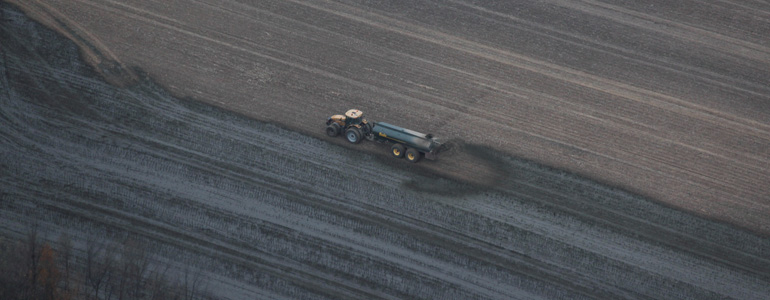
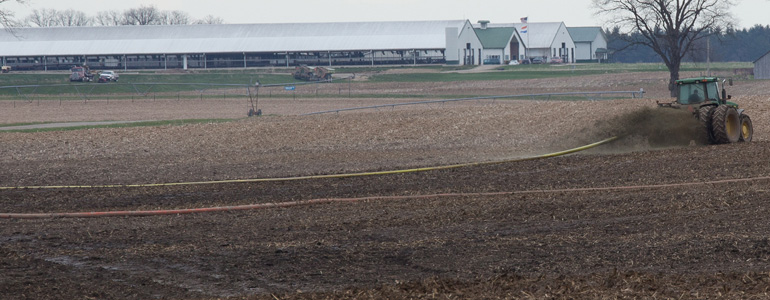
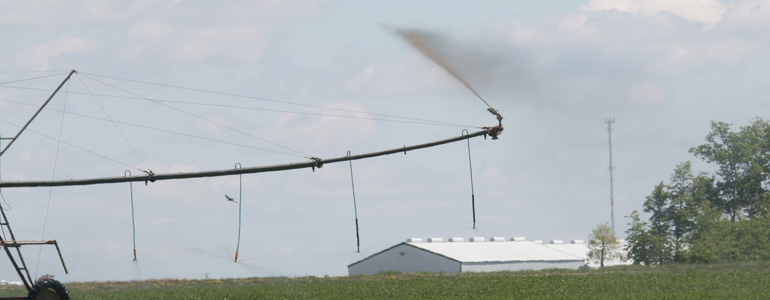
In 2004, Vreba-Hoff was sued by the State of Michigan after multiple and repeated manure discharges and violations. In 2005, the settlement of this suit required Vreba-Hoff to install a partial waste treatment system, separating manure liquids and solids. Solids must be composted, but the partially treated liquid is mixed with untreated, and contaminated, silage leachate and facility washwater. This contaminated liquid is then "irrigated" onto fields. This waste, as liquid as water now, has the potential to move quickly to drainage tiles and to streams. The settlement required no water monitoring downstream. 

"Partial" treatment is the key -- the liquid applied to fields is still contaminated with high levels of nutrients (Phosphorus, nitrates), which lowers Dissolved Oxygen in streams.  Lake Erie's new "dead zone" has recently been linked to Phosphorus runoff from livestock waste.

In January 2006, before liquid separation/irrigation began, ECCSCM sampled 6 streams that originate on and drain only Vreba-Hoff property. The winter baseline data showed no violation of Michigan's water quality standard for DO. The DO monitoring has continued through spring and summer.

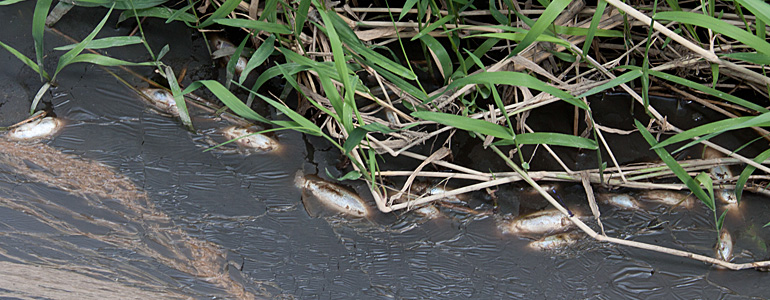
Since the spray-irrigation of fields has begun, two sites have shown immediate and serious degradation of water quality.  Dissolved Oxygen levels plummeted in Medina Drain, first in April and again in June; Durfee Creek has violated Michigan Water Quality Standards for DO in every sampling since April 19, 2006. To meet water standards, DO must be 5 mg/L or higher; less than 3 mg/L deprives aquatic life of oxygen and fish can die.  Durfee Creek DO levels in the last 4 samplings have been: 3.6 mg/L, 2.4 mg/L, 3.4 mg/L, and on June 8, 2006, 1.3 mg/L.

Photos show intolerable levels of Dissolved Oxygen in two streams draining Vreba-Hoff fields. Aquatic life cannot survive.

  
Durfee Cr (left) and Medina Dr (right), June 8, 2006. These sites are immediately downstream from travel irrigators.
See total data of the DO monitoring in progress.

Summer 2004 Mussel Survey
A survey of freshwater mussels in Bean Creek Watershed was conducted in Summer, 2004, by the Michigan Natural Features Inventory, a program of Michigan State University. Some stream stretches were rich with mussel species; sites in one stream -- Silver Creek -- had no live mussels at all, indicating serious degradation of water quality.  See more details, photos.

Bacteria, Dissolved Oxygen Water Monitoring
In response to CAFO pollution in the Hudson area, residents formed Environmentally Concerned Citizens of South Central Michigan (ECCSCM). Volunteers began periodic water monitoring in the Bean Creek Watershed in the summer of 2001. In January 2002, ECCSCM received a Community Action Grant from Sierra Club for more extensive monitoring of streams and drains adjacent to CAFOs. Since then, volunteers have sampled 79 sites, more than 400 water samples. The project tests for Dissolved Oxygen, which is critical for healthy aquatic life, and for E. coli bacteria, an indicator for risks to human health.

After two years of sampling, monitoring has documented that liquid manure moves through underground field tiles and contaminates our streams. The project has shown increasingly low DO levels in several waterways, jeopardizing aquatic life. Many sampling sites downstream from CAFOs show serious bacterial contamination whenever liquid manure is applied, but especially in spring thaws and in fall after crops have been harvested and waste is applied heavily.

See Water Monitoring Project Summary page with Total Data
(also Summary letter to legislators and state agencies, Sept. 1, 2003)


Volunteers sampling a wetland adjacent to CAFO

In 2004, ongoing ECCSCM volunteer water monitoring includes routine documentation of drains and streams, with spot water samples taken when conditions warrant.

Air Monitoring
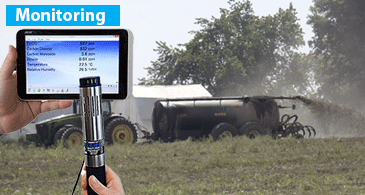
In 2004, ECCSCM began monitoring air quality adjacent to CAFOs and to fields with liquid manure application.  CAFOs are major sources of air emissions that can jeopardize neighbors downwind of the facility and of manure-application fields.  Aquatic ecosystems also suffer, as ammonia settles out of air into streams and lakes. ECCSCM uses a hand-held Draeger Micro-pak digital hydrogen sulfide meter.

Hydrogen sulfide meter, at 3 ppm, 1 mile from CAFO

Toad Creek: How Not to Treat a Stream
Toad Creek, south of Hudson, is a sad story in the degradation of streams near CAFOs. A few years ago, Toad Creek ran clear, with freshwater mussels, fish, and of course toads!
Now, though, water quality is often poor, the water murky or discolored. Throughout 2002, water testing showed spikes in bacterial loading (see chart below) as much as 300 times the allowable level for partial body contact. The worst months for E. coli contamination were February, March, July, and November. On the sampling day of the photo above, November 11, 2002, water tests showed E. coli levels at 297,000/100 ml. Several times at this site, the Dissolved Oxygen (DO) levels plummeted, a bad sign for aquatic life. The Michigan water standard for Dissolved Oxygen is 5 mg/L or higher. In August, 2002, all samplings were below 5 mg/L at this site. And on August 21 and August 28, the DO at Toad Creek bottomed out, well below fish-kill level, 1.8 and 1.7 mg/L.

Toad Creek at Mulberry Road, Sampling Chart (February 2002-November 2002)